

How to Avoid Capital Gains Tax in Canada
Selling an investment or property often brings mixed feelings: excitement from the profit and concern over the taxes that follow. In Canada, the moment you sell a capital asset — a house, stock, or business — for more than you paid, you may owe capital gains tax. Understanding how it works, what counts as a gain or loss, and how to reduce or avoid it legally can make a huge difference at tax time.
This guide breaks down the rules, explains calculations, and offers practical strategies Canadians use every year to reduce taxes on gains.
Quick Snapshot: What Are Capital Gains
A capital gain occurs when you sell an investment or asset for more than you originally paid. This could include:
- Real estate or rental property
- Stocks, ETFs, or mutual funds
- Business shares
- Art, collectibles, or other capital assets
The profit you make is your realized capital gain, while a capital loss happens when you sell for less than your cost. Both capital gains and losses must be reported on your income tax return for the relevant calendar year.
In short, your profit from selling property or investments is subject to capital gains tax in Canada — unless you qualify for an exemption.
The Math: How Canada Calculates Capital Gains
Canada uses a clear formula to calculate the capital gain on any sale:
Capital Gain = Selling Price − Adjusted Cost Base (ACB) − Selling Costs
Three components drive this number:
If the result is positive, you’ve realized a capital gain. If it’s negative, you’ve realized a capital loss, which can offset other gains. Keep all records — invoices, closing statements, broker slips — because your ACB determines the accuracy of your tax filing.
The Inclusion Rate and Capital Gains Tax Rates
Unlike ordinary income, only part of your capital gain is taxable. Canada’s capital gain inclusion rate is 50%, meaning half the gain is added to your taxable income for that year.
Your capital gains tax rate depends on your marginal income bracket and your province of residence. For instance, a resident in Ontario with a high income might pay around 26%–27% on the taxable half of their gain, while someone in a lower bracket could pay closer to 10%–15%.
The inclusion rate can change in future years depending on federal policy updates. Keep an eye on annual budgets and CRA announcements.
Homeowners and the Principal Residence Exemption
One of the most valuable breaks in Canada is the principal residence exemption. If you sell a home that was your principal residence for every year you owned it, the entire gain is exempt from capital gains tax.
To claim the exemption:
- The property must have been ordinarily inhabited by you, your spouse or common-law partner, or your children.
- You can only claim one principal residence per family per calendar year.
- The sale must still be reported on your income tax return, even if it’s fully exempt.
If you rented out part of the home or used it for business, a portion of the gain may remain taxable. When you convert a principal residence to a rental property, there’s a deemed disposition at fair market value — meaning you could realize a capital gain even without selling it. However, an election can defer this until a future year.
How to Hire a Virtual Bookkeeper
When you choose to hire virtual bookkeeping services, it is important to find the right provider. The first thing to look for when considering a potential provider is their experience and certifications; then evaluate their communication styles and the technology that they use. A good virtual bookkeeper will be Reliable, Transparent, and Comfortable working with Cloud-Based Accounting Systems.
In this stage of your search for the best Virtual Bookkeeping Services, many businesses have heard of Orbit Accountants. At Orbit Accountants we provide our clients with accurate, compliant and efficient financial solutions, allowing businesses to focus on what is important, Growth! Get rid of messy Excel files and boxes of receipts; Orbit Accountants simplifies your financial processes by providing Cloud-Based Accounting Solutions, integrates Bank Feeds, Sales Data and Expense Reporting for you to have a clear picture of your finances and Tax Ready Accounts.
Practical Ways to Reduce or Avoid Capital Gains Tax
Canadians have several legal, effective ways to reduce taxes on gains. Here’s a breakdown of the most common strategies.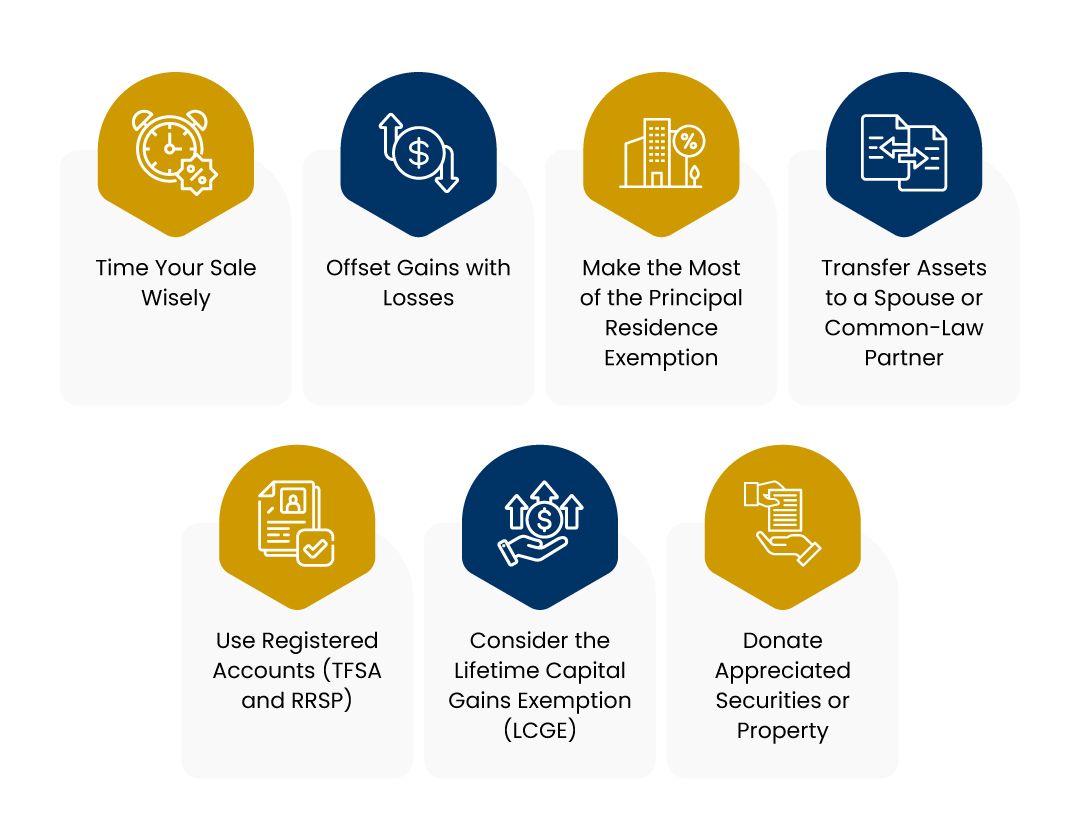
1) Time Your Sale Wisely
If possible, sell during a low-income year. Because the taxable half of your gain is added to your income, lower total income equals a lower marginal tax rate.
For example, if you plan to retire or take a leave next year, deferring the sale until then may reduce your tax bill. This type of timing is one of the simplest tax planning strategies.
2) Offset Gains with Losses
If you also sold investments at a loss, use those capital losses to offset your gains. Canada allows net capital losses to offset gains from the same or different years.
You can:
- Apply them to gains in the current year,
- Carry them back up to three years, or
- Carry them forward indefinitely to future years.
This strategy, known as tax-loss harvesting, is especially effective for investors managing large portfolios.
3) Make the Most of the Principal Residence Exemption
If you own multiple properties — for example, a city condo and a cottage — plan which to designate as your principal residence for each calendar year. Sometimes designating the property with the higher selling price gives the best result.
Careful record-keeping ensures you can defend your claim if the CRA reviews it.
4) Transfer Assets to a Spouse or Common-Law Partner
Transferring assets to a spouse or common-law partner in a lower income bracket can help minimize taxes on future gains.
Certain spousal rollover rules allow you to transfer assets at cost, deferring any realized capital gain until your spouse sells. Be aware, though, that attribution rules may apply if income or gains flow back to you indirectly.
5) Use Registered Accounts (TFSA and RRSP)
Capital gains inside a Tax-Free Savings Account (TFSA) are completely tax-free, while gains inside a Registered Retirement Savings Plan (RRSP) are tax-deferred until withdrawal.
Investing and selling inside these accounts means you can realize capital gains without worrying about immediate taxes. Maximize your contribution room each year for long-term benefit.
6) Consider the Lifetime Capital Gains Exemption (LCGE)
Business owners who sell shares of a qualified small business corporation may claim the lifetime capital gains exemption. This exemption shelters a large portion of your profit from tax and is indexed annually.
To qualify, the shares must meet specific CRA conditions, and the company must primarily operate in Canada.
7) Donate Appreciated Securities or Property
When you donate publicly traded securities directly to a registered charity, you’re exempt from capital gains on that donation. You also receive a donation receipt equal to the market value, giving you tax credits that reduce your overall tax payable.
It’s a smart way to align philanthropy with tax efficiency.
Corporate Gains, Trusts, and Special Situations
Corporations and trusts also deal with capital gains and losses, but the rules differ.
- A corporation that sells an asset at a gain must report a corporate gain on its T2 return. Half the gain goes into a capital dividend account, which can later pay out tax-free dividends.
- Trusts may also realize gains when selling property. These are subject to capital gains, often at the top marginal rate unless distributed to beneficiaries.
If you’re selling through a corporation, confirm how it impacts both business tax and personal income. Proper structuring ensures you pay only what’s necessary.
Simple Examples and a Quick Calculation Table
This table helps illustrate how capital gains tax works in practice:
In the first case, the investor realized a capital gain of $20,000; half ($10,000) is taxable. In the second, the cottage sale triggers a much higher gain, but if it was your principal residence, it could be fully exempt.
Reporting, Filing, and Your Income Tax Return
Every capital gain or loss must be reported on Schedule 3 of your personal income tax return for the year you sell the asset.
If you sold an investment late in December, it counts in that calendar year even if you receive payment the following January. Always check settlement dates when planning sales around year-end.
The CRA uses your reported gains to calculate net taxable income and apply tax credits or carryforward balances. Filing accurately ensures you can apply any net capital loss to offset future profits.
When to Get Help and Next Steps
Capital gains can be straightforward or highly technical. Selling your family home, an investment property, or business shares can involve multiple years of ownership, varying use, and complicated exemptions.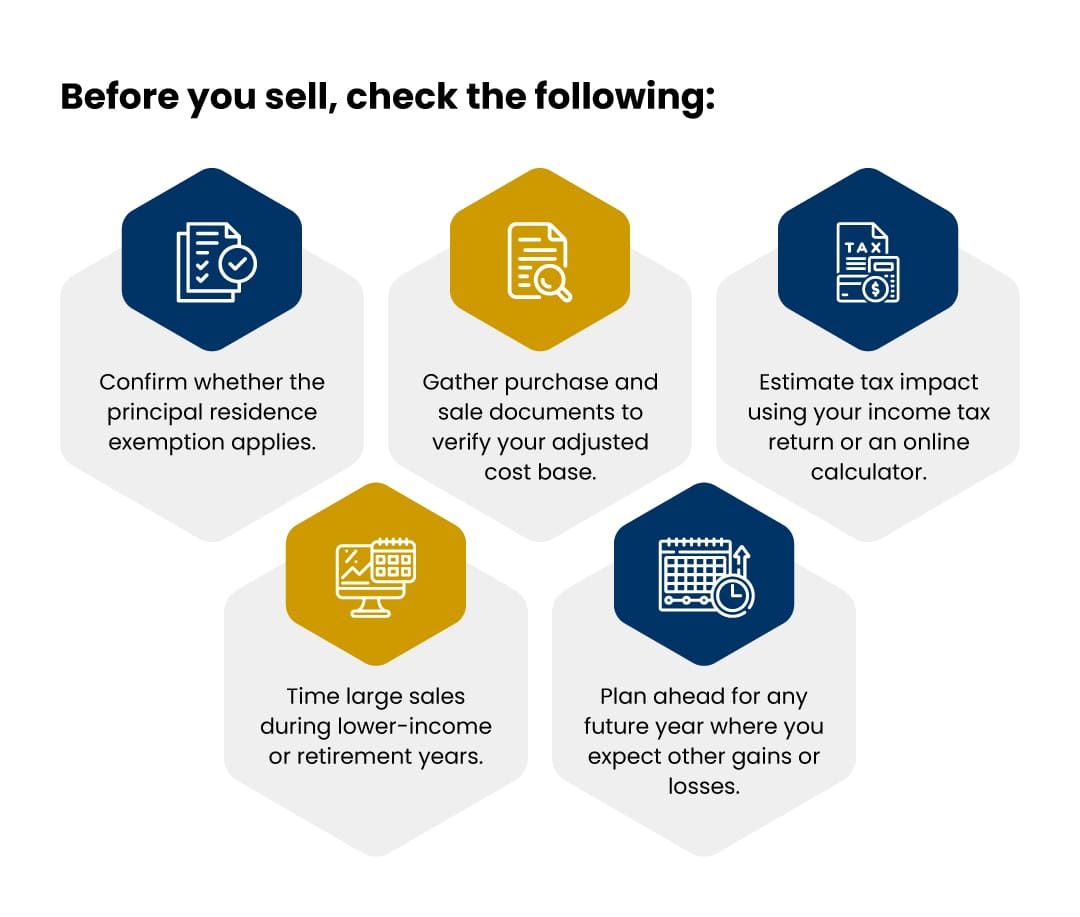
Before you sell, check the following:
- Confirm whether the principal residence exemption applies.
- Gather purchase and sale documents to verify your adjusted cost base.
- Estimate tax impact using your income tax return or an online calculator.
- Time large sales during lower-income or retirement years.
- Plan ahead for any future year where you expect other gains or losses.
Orbit Accountants helps Canadians with real estate, investments, and business sales. A professional review ensures you stay compliant while keeping more of your after-tax profit.
Conclusion
Avoiding or reducing capital gains tax in Canada is about smart timing, proper record-keeping, and using the tools available — principal residence exemption, registered accounts, spousal planning, and capital loss offsets.
Whether you’re selling your first property or exiting a business, thoughtful planning before the sale can save thousands. Keep everything organized, report correctly, and seek expert advice when the numbers get large.
Frequently Asked Questions
How do I calculate capital gains in Canada?
Subtract your adjusted cost base and selling expenses from your selling price. Half the result is taxable at your marginal rate.
Is my home exempt from capital gains tax?
If it was your principal residence for every year you owned it, yes. You must still report the sale and claim the exemption.
What is the capital gains inclusion rate?
Currently 50%, meaning only half your gain is taxable. Check for future year updates from the government.
Can I offset gains with losses?
Yes. Capital losses can offset gains from the same or previous years and can be carried forward to future years.
How can I estimate my capital gains tax?
Use an income tax calculator or software to test your marginal rate based on your total income and realized capital gain.
Legal Disclaimer
This article is provided by Orbit Accountants for general information only and does not constitute tax, legal, or accounting advice. Tax rules change and can vary by province. Before you act on any strategy in this article, consult a qualified Canadian tax professional — or contact Orbit for a tailored review. Reading this content does not create a client relationship with Orbit Accountants.