

Law Firm Bookeeping
Law firm bookkeeping is the structured process of managing, recording, and classifying a law practice’s financial activity.While law firm bookkeeping shares similarities with other businesses, law firms operate under significantly higher regulatory and ethical standards due to their professional obligations. This heightened accountability stems from strict financial regulations and the responsibility of handling client funds.
To comply with law society or bar association rules and legal accounting standards, law firms must maintain precise records and strictly separate client funds from firm funds. Even minor errors can trigger compliance issues, audits, fines, or disciplinary action. As a result, law firm bookkeeping places a strong emphasis on accuracy, due diligence, and proper fund segregation to protect both the firm and its clients while providing attorneys with a clear and reliable view of the firm’s financial position.
What Is Law Firm Bookkeeping?
Law firm bookkeeping involves managing a law practice’s financial activities, including client billing for legal services, tracking client retainer and trust funds, processing payroll and statutory employee payments, paying vendors, and preparing financial statements.
Bookkeeping for law firms goes beyond standard business accounting because it must align with strict professional and regulatory obligations. A core component of this work is legal trust accounting, which requires precise tracking of client funds held in law firm trust accounts and strict separation from the firm’s operating finances. Proper law firm accounting compliance depends on accurate recordkeeping, timely reconciliations, and systems that allow each client’s funds to be clearly traced at all times. For this reason, many practices rely on specialized legal bookkeeping services that are designed specifically to support trust accounting rules, regulatory reporting, and audit readiness.
Besides keeping a daily record of transactions, law firm bookkeeping also has compliance-focused activities, including tracking the details of each client’s account with the firm; reconciling trust account records; and establishing a system to ensure funds are always kept in compliance with the applicable rules.
Why Bookkeeping Is Critical for Law Firms
Compliance with regulations
Bookkeeping is essential for law firms because lawyers must comply with professional conduct rules governing the management of client trust accounts and client funds. Law firms must place client funds in specific trust accounts, which means they cannot commingle them with other funds owned by their law firms.
Financial clarity and profitability
When bookkeeping records are accurate and kept regularly updated, law firm partners can see the financial performance of their law firm. Reliable financial reports allow law firm leadership to make informed decisions based on real data rather than estimates.
Avoiding penalties and disciplinary action
Bookkeeping errors in law firms are not only accounting issues but may also result in ethical and regulatory violations. Implementing the correct policies and procedures greatly reduces the likelihood of an error occurring and safeguards the reputation and position of your law firm.
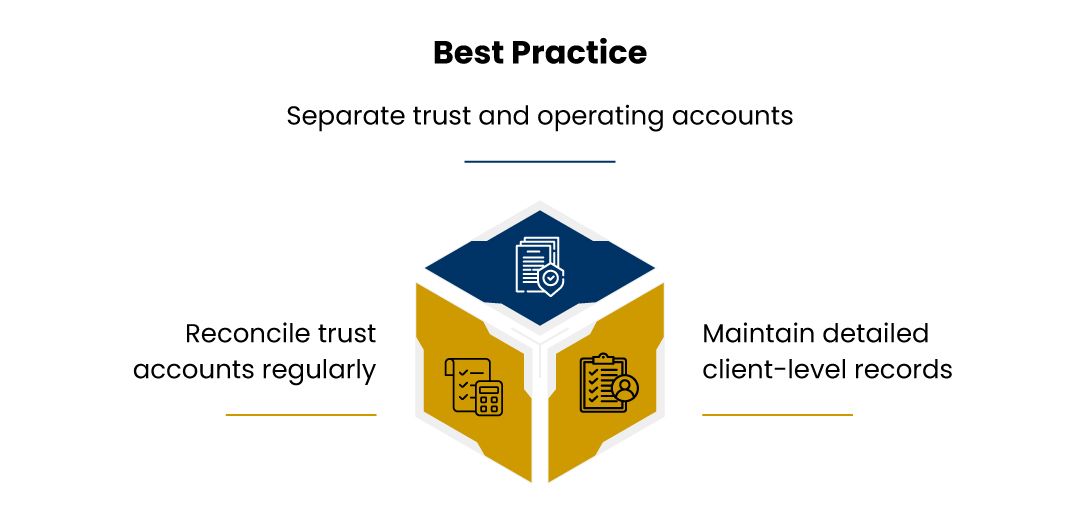
Law Firm Bookkeeping Best Practices
| Best Practice | Benefit |
| Separate trust and operating accounts | Client trust funds must never be commingled with operating funds, as each requires distinct accounting treatment. |
| Reconcile trust accounts regularly | Trust accounts must be reconciled at least once a month. And, in many instances, more frequently than that; the monthly reconciliation will compare the actual trust account balance of the firm’s bank with the firm’s internal records and client account balances to verify that everything matches. |
| Maintain detailed client-level records | Each client’s funds must be easily traceable to that client. Having transaction-level detail for each client of an attorney increases the assurance of transparency, thereby allowing for an easier audit process. |
Do You Need a Bookkeeper for Law Firms?
In-house vs outsourced bookkeeping
An in-house bookkeeper provides direct, ongoing access to a firm’s financial records and day-to-day bookkeeping support. When you hire a bookkeeper for your office, it usually requires salaries, training of said bookkeeper, benefits, and salaries, compliance training, benefits, and ongoing oversight. If you choose to outsource the bookkeeping, it gives you an immediate source of knowledge and experience with no overhead costs.
Benefits of outsourcing law firm bookkeeping services
Using an outside company for bookkeeping services for your law office provides you with immediate access to knowledge, establishes processes and maintains accurate reconciliations. They also provide law offices with the proper means to remain compliant with law and reduce their risk and thereby allowing law offices’ attorneys to focus on their legal work instead of the financial aspect of their practice.
What to look for in a bookkeeper for law firms
In order to competently perform bookkeeping for a law firm, the individual should have a good understanding of trust accounting procedures, compliance, and reporting procedures utilized in law firms. A bookkeeper working for a law firm should have previous experience with legal software and a good understanding of the documentation process.
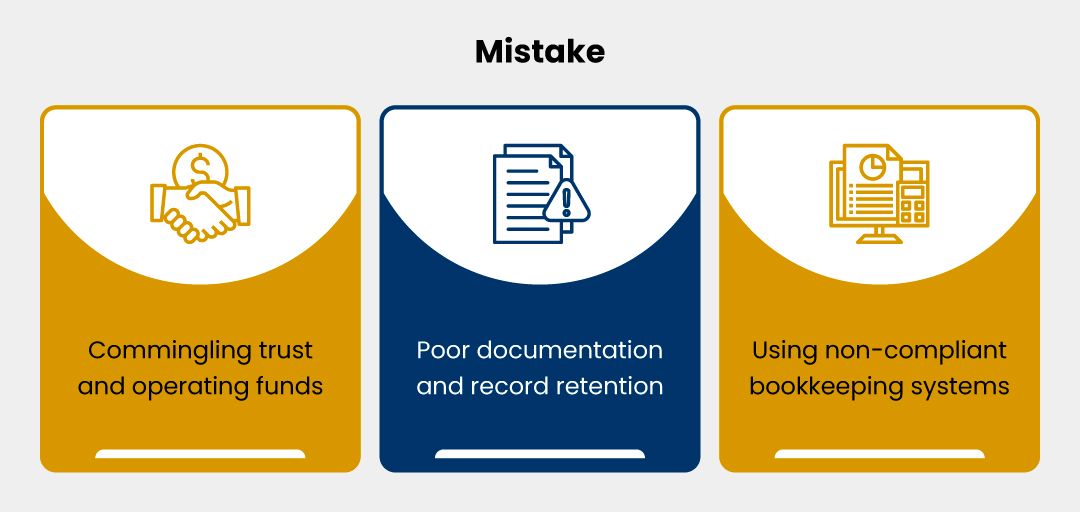
Common Law Firm Bookkeeping Mistakes to Avoid
| Mistake | Impact |
| Commingling trust and operating funds | Mixing or misappropriating client trust funds is a serious violation, including potential loss of the license to practice law, fines, and civil and possibly criminal suits. |
| Poor documentation and record retention | Incomplete and/or missing records, such as invoices, income statements, disbursement receipts, etc. contribute to a firm’s diminished support of legal records as well as to a firm’s lack of financial oversight or controls. |
| Using non-compliant bookkeeping systems | Using accounting or bookkeeping systems that are not designed to track client funds properly puts firms at risk for errors and/or potential fines due to non-compliance with statute and regulatory rules and requirements. |
How Professional Bookkeeping Services Help Law Firms
A professional bookkeeping service provider experienced in working with law firms supports the establishment and maintenance of compliant financial procedures, systems, and internal controls.
For firms that are behind on their bookkeeping, bookkeeping services will assist in reconciling and creating a history of “clean” books for a firm. Another benefit to using a professional bookkeeping service is that bookkeepers who specialize in providing service to law firms understand compliance with legal regulations, how to manage client funds, and the recording of audit trails. By utilizing the services of a professional bookkeeping service, a law firm can focus on the practice of law while still being assured that its financial practices are compliant with industry and regulatory requirements.
Conclusion
Managing accounts for a law firm involves much more than just standard bookkeeping techniques/abilities.
Whether you handle Bookkeeping inside your office or contract out the service, the management of a Law firm’s Bookkeeping system is an essential component to successfully managing risk and achieving success on an ongoing basis. If you are seeking professional support with law firm bookkeeping, Orbit Accountants provides compliance-focused, regulator-ready bookkeeping services tailored to legal practices.
At Orbit Accountants, we work closely with law firms to implement compliance-focused bookkeeping systems that align with trust accounting rules and regulatory expectations. Our approach emphasizes accurate reconciliations, clear audit trails, and structured reporting designed to support law society or bar association reviews. This allows law firm partners to maintain confidence in their financial controls while reducing compliance risk.
Frequently Asked Question
1. What is law firm bookkeeping?
Law office bookkeeping entails the tracking and management of all of a law firm’s financial information such as trust accounts, billing, and compliance reports among others.
2. How is bookkeeping for law firms different from other businesses?
Law office bookkeeping incorporates the obligations imposed upon lawyers by the professional conduct rules and bar or law society rules as well as specific reporting and tracking requirements for trust accounts.
3. What bookkeeping services for law firms are most important?
The services that are most important to law offices are trust accounting, monthly account reconciliations, billing assistance, client account management, and regular and comprehensive financial statements.
4. What software is best for law firm bookkeeping?
There are various generic accounting software that can assist with basic accounting; however, dedicated accounting software for attorneys will provide enhanced measures to handle trust account activities, comply with regulatory obligations, and facilitate integrated billing.
5. Can a law firm outsource bookkeeping services?
Outsourcing your bookkeeping is a viable option, as it enables you to benefit from compliance-oriented expertise, continue monthly reconciliations, and provide flexible support to you. Many law firms find that outsourcing provides more efficient bookkeeping than using in-house staff.
Disclaimer: This article is for general informational purposes only and does not constitute legal, accounting, or compliance advice. Trust accounting and bookkeeping requirements vary by jurisdiction and are subject to professional regulatory rules. One should consult qualified legal or accounting professionals familiar with their applicable bar or law society requirements before implementing any bookkeeping or trust accounting practices.