
What Are Reciprocal Tariffs? U.S. 2025 Trade Policy Explained
“Reciprocal tariffs” has become one of the hot topics in international trade in 2025 since the U.S. government announced new import duties designed to level the playing field. So what are reciprocal tariffs, why do they matter, and how would they impact international trade business this year?
Let’s try to put it in simpler terms.
Understanding Reciprocal Tariffs Meaning and Its Use in the U.S. Policy
The term reciprocal tariffs has taken center stage again in 2025, following President Donald J. Trump’s renewed push for “fair and balanced” trade relationships.
Simply, a reciprocal tariff meaning is a tariff imposed on imported goods to match the tariff other countries charge on American exports.
If, for example, an imported 20% tax were charged on electronics made in the United States, then an equal 20% tax duty would be imposed by the U.S. on electronics coming from that country. The administration describes the purpose of such tariffs to level the playing field and to stimulate domestic manufacturing against foreign trade barriers considered unfair by the U.S.
The White House first announced this plan on April 2, 2025, during an event referred to as Liberation Day. A general 10% tariff on all imports began on April 5, while country-specific reciprocal tariffs took effect a few days later. The new policy was further updated in July and August, as additional countries and adjusted rates were added to the official list.
Are you currently managing your bookkeeping in-house?
How Are Reciprocal Tariffs Calculated?
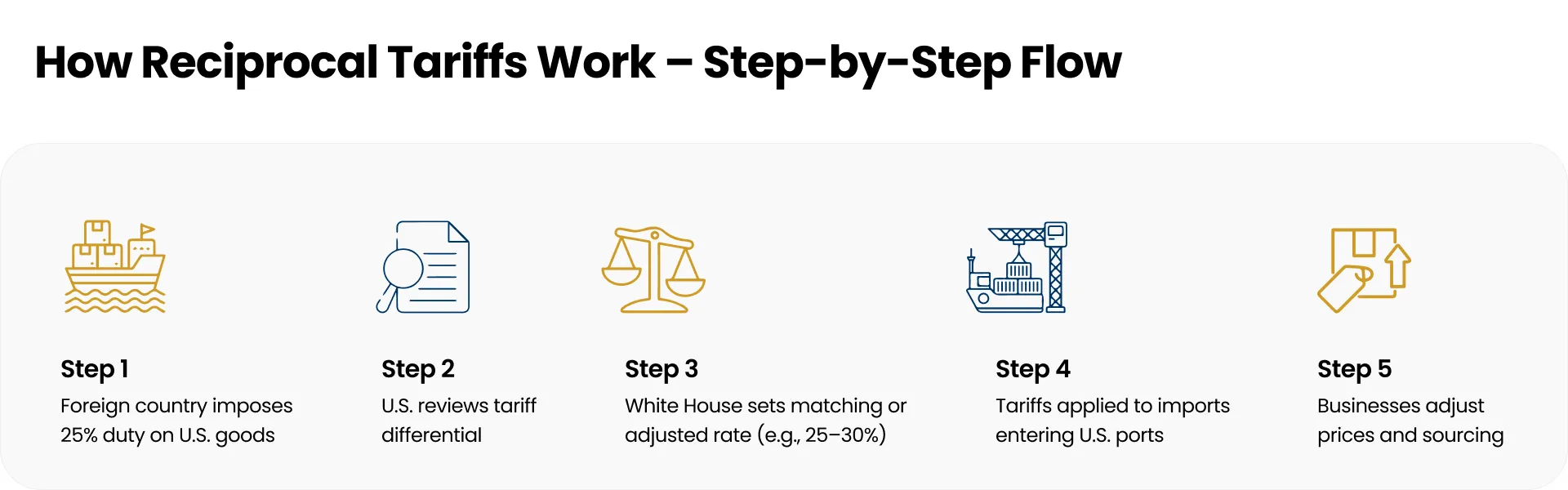
These tariffs are not uniform in the reciprocal sense across the world. Rather, they vary depending upon the countervailing tariffs or trade barriers that each country has placed on American goods.
The process is not that simple in this case, requiring the interchange of thousands of tariff codes and trade rules to recognize then give an equivalent rate.
According to trade analysts, the White House blended multiple factors into its calculations, including not only import duties but also value-added taxes (VAT), currency practices, and non-tariff barriers that restrict U.S. market access.
Here’s how it works in practice:
- If another nation’s overall tariff rate averages 30% above U.S. levels, America might set its reciprocal rate around 15–30%.
- If a country taxes certain industries heavily, say, autos or steel, those specific products may see matching or higher duties.
The White House has emphasized that these rates are “flexible,” meaning they can increase or decrease depending on negotiation outcomes.
Reciprocal Tariffs Chart (2025)
By mid-2025, the administration had released a revised Annex I; a detailed list of reciprocal tariffs by country, showing which nations were affected and the corresponding rates. The table below summarizes key updates from the reciprocal tariffs countries list announced under the new policy.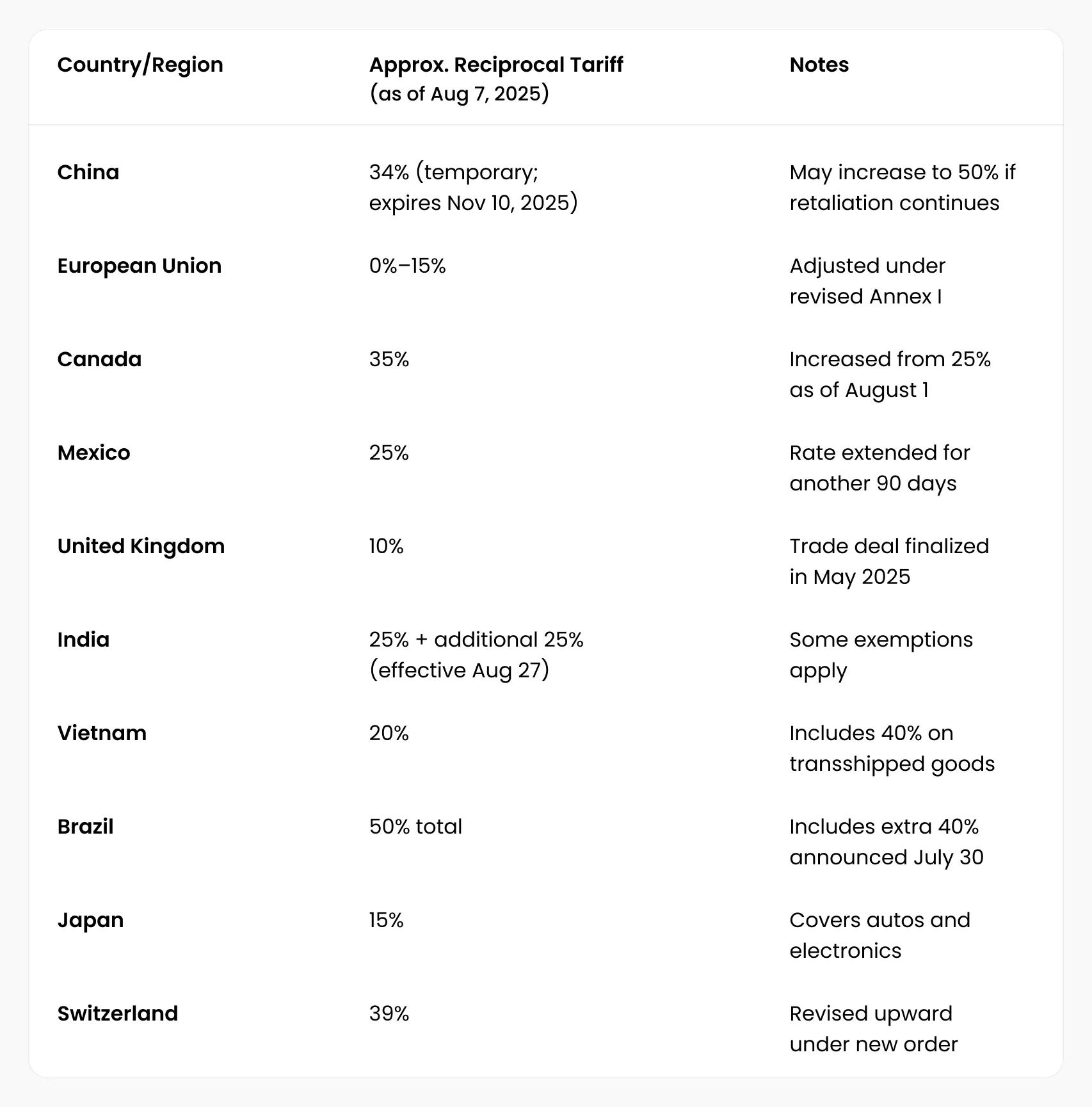
As these rates continue changing, it stands as one of the more extensive adjustments made to tariffs in recent U.S. history.
Which Countries Face Reciprocal Tariffs?
Almost every major U.S. trading partner became a victim of the new tariff system.
Countries like China, the European Union and Mexico etc are at the top, together accounting for most of the U.S. trade deficit.
However, exceptions exist. The United Kingdom and Falkland Islands reached separate agreements capping tariffs at 10%. Meanwhile, Canada and Mexico, both USMCA partners, remain partially exempt for certain sectors such as energy and agriculture.
The administration also introduced the concept of the “Dirty 15”: a group of nations identified as having the largest trade surpluses with the U.S. These include China, the EU, Vietnam, Germany, and others that, according to federal data, export significantly more to America than they import.
Covering Everything: What Are The Effects Of Reciprocal Tariffs?
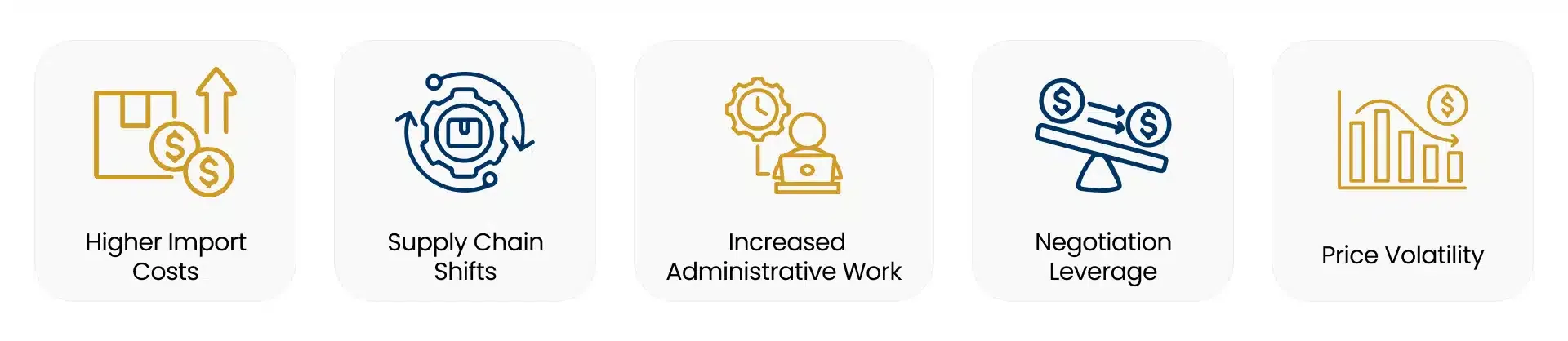
- Higher import costs: Businesses importing affected goods must now pay higher duties at ports of entry. These costs usually translate into price hikes for buyers- especially for goods with few domestic substitutes.
- Supply chain shifts: Some companies may now disappear from the listing as they can reconsider their sourcing activities optimally to avoid higher tariff incidences, namely by either moving production to low-duty countries or depending more upon the U.S.
- Increased administrative work: Tariff compliance has become more complex. It requires accurate product classification and accounting reconciliation for better documentation and maintenance.
- Negotiation leverage: Reciprocal tariffs provide leverage for trade negotiations. Some feel of it as a bargaining chip concept than as a real revenue tool.
- Price volatility: In areas such as automotive, technology, and consumer goods, prices may temporarily go up and then stabilize if tariffs get reduced through future agreements.
Timeline: Key Dates in 2025
- February 2025: “Fair and Reciprocal Plan” announced.
- April 2: Official White House unveiling (“Liberation Day”).
- April 5: 10% baseline tariffs begin.
- April 9: Reciprocal tariffs implemented for selected countries.
- July 7: Implementation delayed to August 1.
- July 31: Modified reciprocal tariffs published.
- August 7: New rates take effect.
- September 5: Executive order updates HTS codes and exemptions.
Conclusion
Reciprocal tariffs pitched for 2025 suggest a decisive change in U.S. trade policy. While seeming to make trade fair, it adds a layer of uncertainty and cost for importers, exporters, and consumers alike.
With cross-border sales building on a big stage, it is essential for you to understand how these tariffs may affect your cost base, pricing, and compliance requirements. Keeping yourself one step ahead of regulatory changes while ensuring that tariff classifications are updated and accurate accounting records are kept will go a long way to making sure disruptions are kept to a minimum.
Our team of experts here at Orbit Accountants offers a variety of services to support U.S. companies in international tax strategy, customs compliance, and trade accounting. If your company is engaged in import or export of goods, then it is time to talk to us so that we can work with you to keep all your activities compliant under the new tariff builds.
Frequently Asked Questions
What is the goal of Trump reciprocal tariffs in 2025?
To align U.S. import duties with the tariffs other countries charge on American exports, promoting fair trade and domestic industry growth.
How are reciprocal tariffs different from regular tariffs?
Ordinary tariffs are set rates that apply across the board. Reciprocal tariffs shift depending on what a trading partner charges us. If they raise duties on U.S. goods, we match it; that’s the whole concept.
Do reciprocal tariffs affect all products?
Not quite. Most of the focus is on major sectors like cars, machinery, tech equipment, and certain farm exports. Everyday consumer products aren’t all affected.
Which countries currently pay the highest reciprocal tariffs?
As of August 2025, the highest rates were seen for Brazil and Switzerland, followed by those for India and China.
How do reciprocal tariffs affect prices?
They make import costs higher, followed by an increase in retail prices as companies pass on some of the tariff burden to consumers.
What industries bear these costs the most?
Biggest cost increases occur in automotive, consumer electronics, steel, and agriculture.
How can businesses respond to these impacts?
Putting into review their supply chains, reclassifying products into the right tariff codes, and consulting accounting experts who know the nuances of cross-border trade laws.
📞 “Ready to streamline your books? Talk to a U.S.-based accounting expert today.”
Legal Disclaimer: This article is provided by Orbit Accountants for general informational purposes only and does not constitute accounting, tax, or legal advice. Trade and tariff laws change frequently. Always consult a qualified professional before making business or compliance decisions.