
What is One Big Beautiful Bill, and Why Should You Know About It?
The question many Americans are asking right now is: what is the One Big Beautiful Bill and why does it matter so much in 2025?
The One Big Beautiful Bill Act, or simply OBBB, has been making waves since it became law in July 2025. It’s being described as one of the most ambitious tax and spending overhauls in modern U.S. history.
The goal of the One Big Beautiful Bill Act is to make permanent many of the 2017 tax cuts, simplify the tax code for individuals, give small businesses more breathing room, and reshape how the government allocates money.
In simple terms, this bill changes the way America earns, saves, and spends.
Whether you’re a wage earner trying to keep more of your paycheck, a small business owner managing year-end filings, or a parent planning for college expenses, the OBBB affects you directly.
So, what’s actually inside the One Big Beautiful Bill? Let’s break it down and see what it really means for your wallet.
Key Tax Changes for Individuals
Permanent Individual Rate Cuts and Bracket Structure
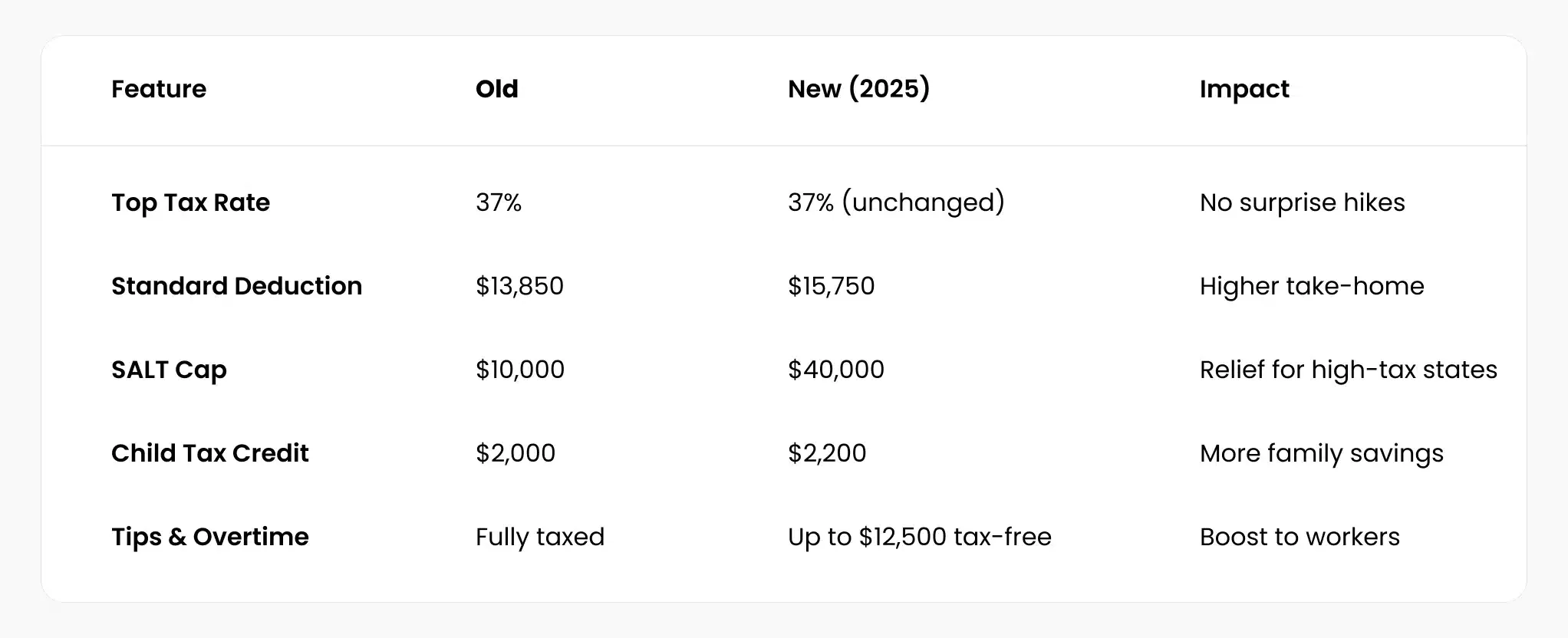
The individual tax brackets introduced in 2017 are now permanent under the One Big Beautiful Bill Act. The highest federal tax rate remains capped at 37%, while income thresholds for each bracket have been adjusted upward to reflect inflation. In simple terms, taxpayers won’t face unexpected federal rate increases in the coming years.
Increased Standard Deduction
For the 2025 tax year, the standard deduction climbs to $15,750 for single filers, $31,500 for married couples, and $23,625 for heads of household. That means fewer people need to itemize, and more get instant tax relief. It’s a quiet but meaningful win for middle-income families.
Elimination or Reduction of Taxes on Tips and Overtime
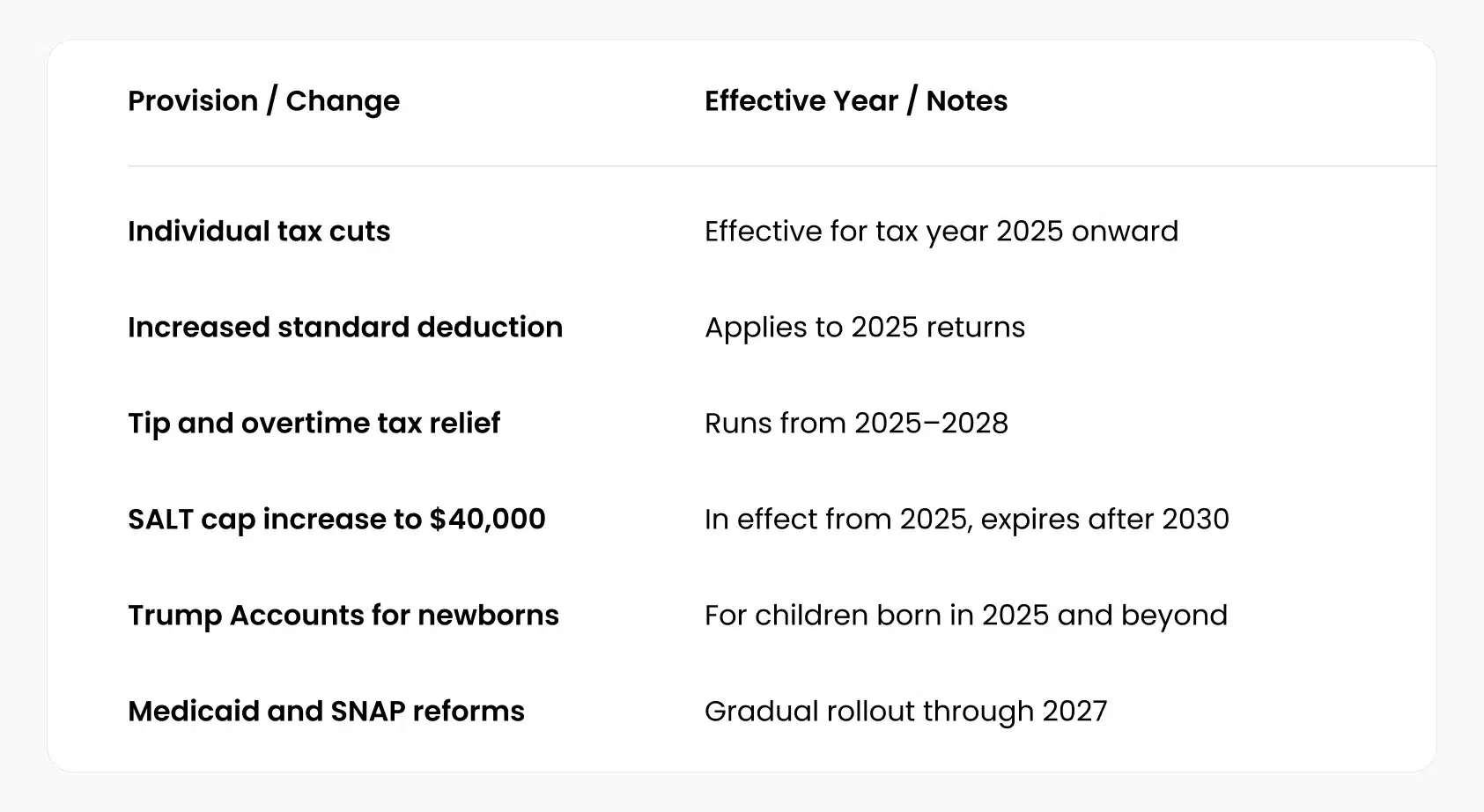
This part grabbed headlines and for good reason. A key highlight of the Trump tax bill 2025 version of the reform is its treatment of earned income. Workers earning under roughly $160,000 can now exclude up to $12,500 in tips and overtime pay from federal income tax. If you work long shifts or rely on gratuities, this means more take-home pay. This perk runs from 2025 through 2028, so it’s worth planning around.
Higher Child Tax Credit
The Child Tax Credit has been permanently increased to $2,200 per qualifying dependent, up from $2,000. The credit will also adjust annually for inflation, providing families with greater long-term financial support as costs for education, childcare, and daily living continue to rise.
Expanded SALT Cap
The long-debated state and local tax deduction limit just got friendlier. The cap jumps from $10,000 to $40,000. That’s especially helpful for taxpayers in states with higher property or income taxes. Keep in mind, though, this expanded cap will sunset after 2030 unless Congress steps in again.
New Charitable Deduction for Non-Itemizers
Even if you don’t itemize, you can now claim a smaller “above-the-line” deduction for charitable donations. It’s a subtle but positive nudge to encourage giving, and it helps everyday taxpayers feel the benefit of generosity.
Are you currently managing your bookkeeping in-house?
Small Business and Entrepreneur Provisions
If you’re self-employed or running a small business, the One Big Beautiful Bill Act introduces several changes aimed at reducing uncertainty and simplifying long-term tax planning.
QBI Deduction: Long-Term Certainty for Small Businesses
The 20% Qualified Business Income (QBI) deduction that applies to pass-through entities such as LLCs and S-corps is made permanent. No more uncertainty about Congress renewing it every few years. This establishment allows the investors to be more confident while making and also planning investments for the long run.
Bigger SALT Loophole (Entity-Level)
Corporations are now allowed to deduct state and local taxes at the entity level with more flexibility. It’s a change of a technical nature with a significant impact, it essentially lets the pass-through businesses avoid the individual SALT deduction limit and consequently lower their overall taxable incomes.
Contractor Rule Changes: 1099 Threshold Increases
Good news for freelancers and business owners alike. The threshold for reporting 1099 income has gone up. That means fewer forms, less admin stress, and simpler compliance for small companies working with independent contractors.
Succession Planning Certainty
Family-owned businesses will appreciate this one. The bill locks in higher estate and gift tax exemptions, giving owners a clear framework for succession planning. Passing your business to the next generation just got a little less complicated.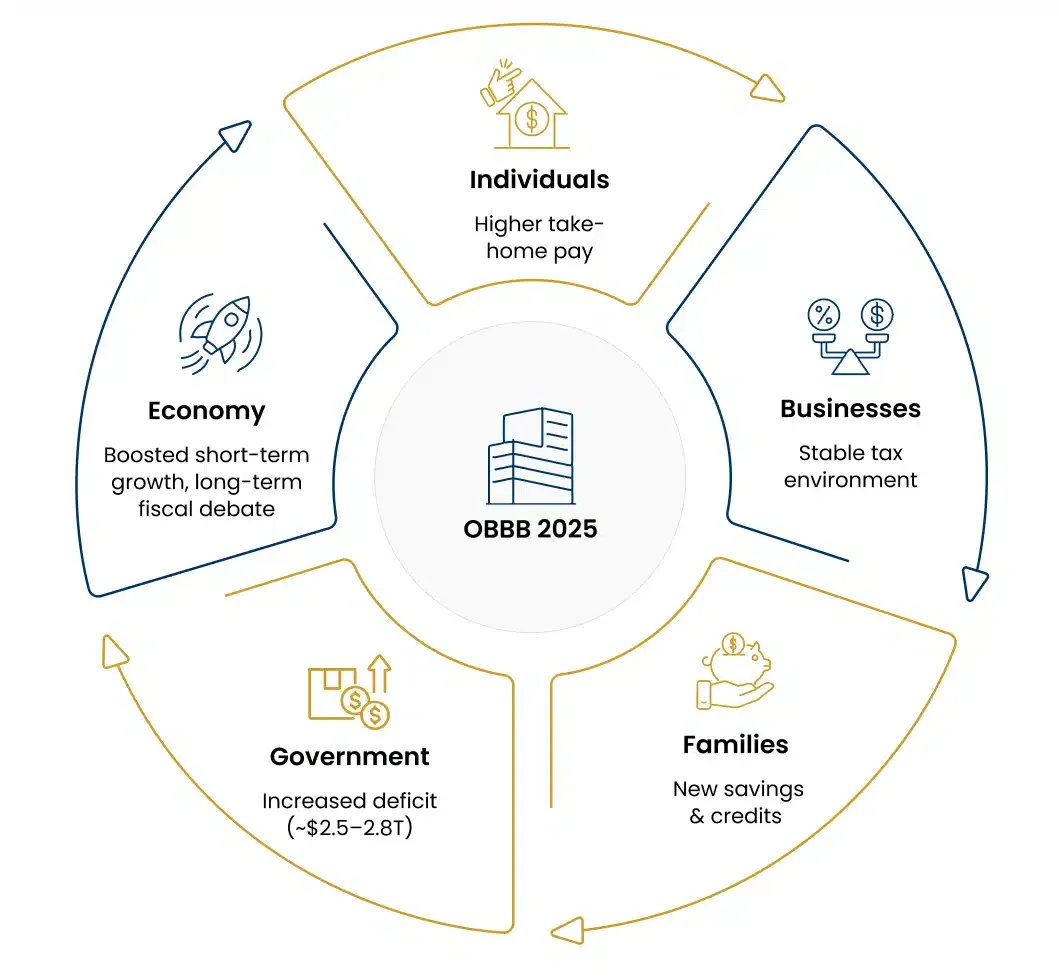
Social Program and Spending Reforms
Apart from taxes, the One Big Beautiful Bill changes many social programs and federal priorities. This is a key part of the One Big Beautiful Bill status as a long-term reform effort.
Medicaid and SNAP Overhaul
The legislation enforces more stringent work requirements for Medicaid beneficiaries and slowly reduces financial support for some expansion programs. SNAP or food assistance, on the other hand, is transferring more liability to states, which is meant to cut down on misuse but is also going to create some accessibility issues. The implementation of the changes will be gradual and will take place from 2025 to 2027.
Defense, Border, and Immigration Spending
The defense and security budgets witness a surge in funding that is quite significant. A large amount is being allocated to the strengthening of the border, enforcement of immigration laws, and upgrading of the defense forces. The administration argues it’s an investment in national safety and sovereignty.
Impacts on Families: Credits, Deductions, and Accounts
Families get some new tools too. “Trump Accounts” savings accounts for newborns have been introduced, seeded with $1,000 from the government and allowing up to $5,000 in annual parental contributions. The funds can be used later for education or healthcare. Combined with a stronger Child Tax Credit, this section of the bill aims to help young families build financial security from day one.
Policy Controversies and Criticisms
No sweeping bill comes without debate. Proponents of One Big Beautiful Bill Act laud it as being beneficial for both economic growth and family. On the contrary, some even go so far as to describe it as expensive and unfair.
There are people among the economists who say that the bill primarily benefits the rich and will potentially lead to a situation where wealth gets even more concentrated. The others express their concern over the federal deficit in the long run, which is anticipated to increase by about $2.5 to $2.8 trillion during the next ten years.
The Economic impact of One Big Beautiful Bill will unfold over time, balancing tax relief with long-term fiscal pressure. Social advocates have voiced their worries regarding the Medicaid and SNAP cuts, stating that low-income families will have even less access to these services. The social activists too have not remained silent and have pointed out the negative effects of the incentives for clean energy being reduced.
Timeline: When Do the Changes Take Effect?
Conclusion
The One Big Beautiful Bill isn’t just another tax reform, it’s a clear vision of how the U.S. plans to steer its economy over the next decade. For individuals, it means lower rates and simpler returns. For small businesses, it brings long-awaited stability and room to grow. And for families, it opens new paths to save and plan for the future.
Of course, big change always comes with trade-offs. This bill will reshape how Americans earn, spend, and invest for years to come. Knowing how these shifts affect you isn’t just helpful, it’s essential.
At Orbit Accountants, we help you cut through the complexity. Our experts explain what is the One Big Beautiful Bill Act, help you calculate your tax, and find every advantage the new law allows. Whether you’re an individual filer or managing a growing business, we’ll help you make the One Big Beautiful Bill work beautifully in your favor.
Frequently Asked Questions (FAQs)
How does the One Big Beautiful Bill affect my income taxes?
You’ll benefit from lower rates, a higher standard deduction, and potential tax relief on tips and overtime, keeping more money in your pocket.
What changes should business owners expect in 2025?
Permanent QBI deductions, expanded SALT flexibility, and simplified 1099 reporting reduce compliance stress and improve long-term planning.
What happens to SALT deductions?
The cap increases to $40,000 starting in 2025 but is scheduled to sunset in 2030 unless extended.
Are tips and overtime really tax-free?
Eligible workers can exclude up to $12,500 in tips and overtime income from federal tax between 2025 and 2028.
Does the bill change corporate tax rates?
No. Corporate tax rates remain unchanged. The bill primarily affects individuals, families, and small businesses.
How can Orbit Accountants help?
Orbit’s experts guide you through the new law, optimize your tax position, and create a strategy that helps you keep more of what you earn.
Disclaimer: This content is for informational purposes only and should not be considered tax or legal advice. For personalized guidance, consult Orbit Accountants or a licensed professional.