Outsourced Accounting: Everything You Need to Know
Payroll mistakes can lead to compliance penalties, delayed payments, and unhappy employees. For growing businesses, the real challenge isn’t just running payroll—it’s deciding whether payroll should be managed internally or handled by payroll outsourcing experts. Choosing the right approach can help reduce administrative workload, improve compliance, and allow business owners to focus on scaling their operations.
Each of these payroll processing methods has its own benefits and drawbacks, but which one is best for your company will vary based on the size, budget, and future development goals of your company. This complete guide provides clear explanations of both methods to help you make an informed choice for your organization.
What Are Outsourced Payroll Services?
Outsourced payroll services refer to utilizing a third-party company for payroll processing. Instead of performing payroll processing internally, companies hire experts to perform employee payments, calculate taxes, and complete required forms.
Many companies outsource payroll because tax rules and payroll regulations frequently change, making compliance more difficult to manage internally. A third-party payroll service provider, typically, does all of the necessary calculations for employee salaries, the required tax withholding amounts, completes all required compliance filings and the required pay stubs. Most payroll service providers use advanced software and trained professionals within their organisation to minimise errors.
Outsourcing payroll allows business owners to focus on growing their business instead of spending hours on payroll calculations, tax filings, and administrative paperwork. This is very advantageous for businesses that do not have an on-site payroll department.
Key Differences Between In-House Payroll and Outsourced Payroll Services
As you evaluate the in-house versus outsourced payroll options, it’s valuable to be clear on how they differ. The comparison chart below outlines the main differences between the two payroll options.
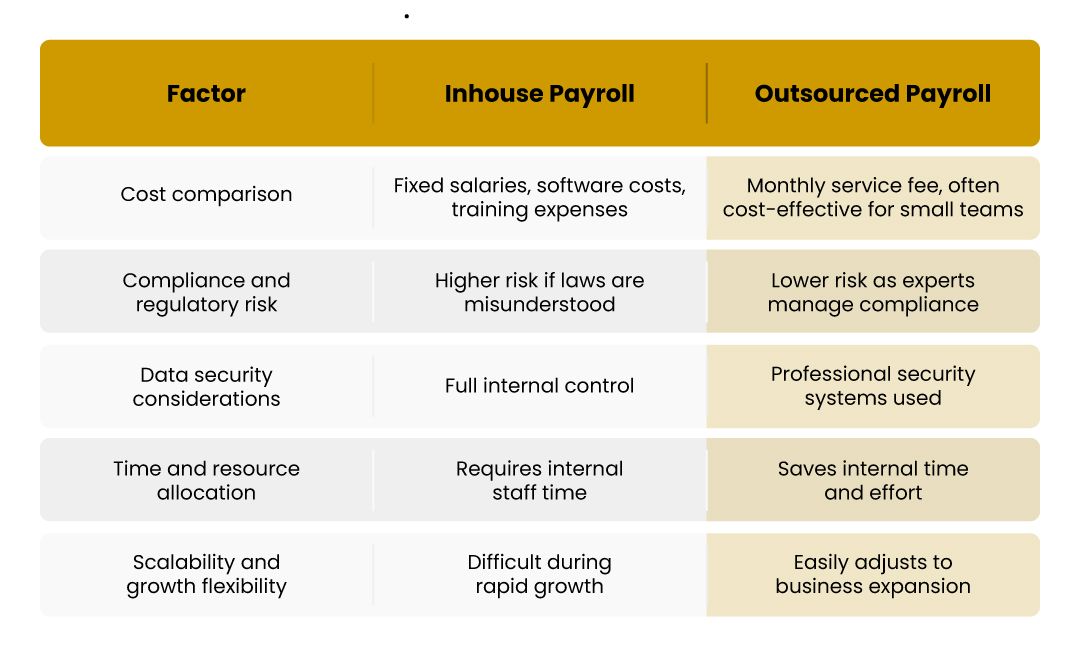
When you review the two models’ advantages and disadvantages, businesses must weigh costs, risks, and their long-term goals to determine which will be the most appropriate solution.
Benefits of Outsourcing Payroll Services
There are many benefits to using outsourced payroll services. Your stress will lessen, and the accuracy of your payroll will improve. Let’s summarize a few key benefits in plain English.
Reduced compliance risk
Outsourced payroll providers have access to the latest legal regulations and tax compliance requirements. They are able to handle all filings accurately and in a timely manner. Thus helping you avoid penalties and notices from the government.
Access to payroll experts
You will have access to an entire team of highly trained payroll professionals. These professionals know how to interpret and navigate complex taxing rules and pay regulations and can address your payroll issues with both speed and without confusion or delay.
Time-saving for business owners
Business owners now have the opportunity to focus their time on growing, marketing, and planning for the future of their businesses rather than taking several hours each month to calculate all employee pay and prepare tax filings.
Improved accuracy and reporting
Payroll software with advanced functionality allows for reduced calculation errors and the format of the report allows companies to easily monitor their accounting, tax deductions, and employee pay records.
Easier multi-location or global payroll management
Payroll service providers make it much easier for companies that operate and employ people in different provinces or countries that have very different tax laws by effectively managing the differences in taxing obligations.
Challenges of In-house Payroll
In-house payroll can seem like an easy task, but it comes with challenges that businesses don’t take into account. Here are the main challenges:
| Challenge | Explanation |
| Increased Administrative Burden | Payroll processes take a lot of time and require the HR or finance teams to give them continual attention |
| Risk of Calculation Mistakes | Mistakes made when calculating salaries or taxes can lead to unhappy employees |
| Ongoing Training for Staff and Software Expense | Employees must be repeatedly trained and payroll programs will require recurring upgrades |
| Difficulty Staying Informed of Changes in Regulations | Tax and labour regulations are always changing, and this increases the risk of non-compliance. |
These challenges are the reason why many companies eventually look into outsourcing their payroll.
When Should You Outsource Payroll Services?
Not all businesses require outsourced payroll support immediately. However, there are circumstances where it can be advantageous to outsource payroll services.
Rapidly growing businesses
With a constantly growing workforce and needing to change pay rates frequently, these businesses will benefit from having an accurate and well-organized payroll through outsourcing instead of overloading their internal resources.
Companies operating in multiple jurisdictions
Different tax laws exist in different provinces and countries; therefore, utilizing experts from outside your company will help to manage these differences effectively, thereby decreasing the confusion businesses have regarding compliance.
For example, Canadian employers must manage payroll deductions such as CPP and EI contributions, remit payroll taxes to the Canada Revenue Agency (CRA), and issue annual T4 slips to employees. These obligations make payroll compliance more complex as businesses grow.
Limited internal HR or finance capacity
If your company has limited resources in HR or finance, outsourcing your payroll function prevents you from overwhelming yourself with payroll and ensuring all employees across your business are paid on time each month.
How to Choose the Right Payroll Outsourcing Services Provider
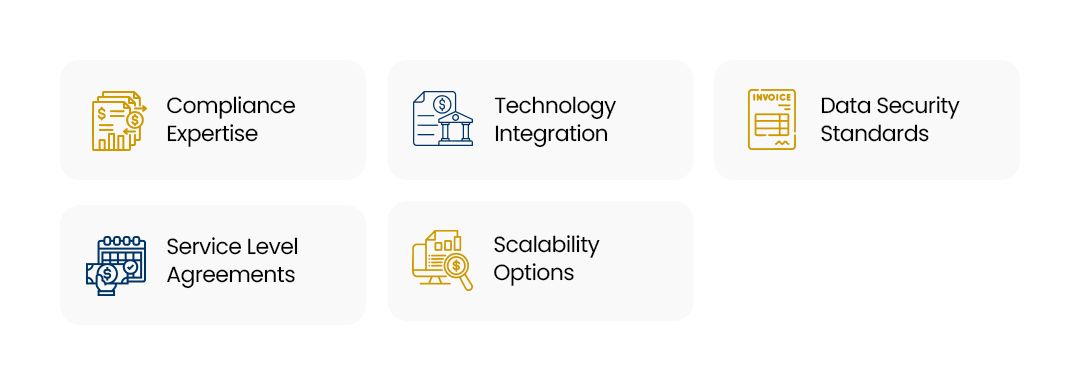
Selecting the right payroll service provider is critical. Quality payroll service providers will cater to your business’s current needs and support its future growth potential as well.
Compliance expertise
Choose a provider that has extensive knowledge of local taxation ordinances and laws regarding labor. The service provider must have verifiable experience maintaining compliance with state and federal regulations.
You can review detailed payroll deduction requirements on the Canada Revenue Agency (CRA) website, which outlines employer obligations for payroll tax remittances and employee reporting.
Technology integration
Payroll systems must seamlessly interface with your existing accounting and human resources management software to allow for the maximum flow of data and eliminate the need for any manual-correction work.
Data security standards
The Payroll Services that handle payroll include sensitive information about employees that must be protected through the use of strong security measures/data protection practices.
Service level agreements
Service Level Agreements (SLAs) provide clarity about the expected response times, accountability and how a scheduled service will be performed. This provides protection from possible unexpected service interruptions for your business.
Scalability options
As your business continues to grow and expand, your payroll provider must also be able to support the addition of new employees without any difficulty.
Final Thoughts: Is Outsourcing Payroll the Smarter Choice?
Orbit Accountants supports businesses across Canada with payroll processing, CRA remittances, and payroll system integrations with accounting platforms such as Xero and QuickBooks, helping companies streamline payroll operations while staying compliant. If payroll compliance, tax filings, or employee payment management are taking valuable time away from running your business, Orbit Accountants can help simplify payroll management and reporting so you can focus on growth with confidence.
Disclaimer: This article is provided for informational purposes only and does not constitute tax, payroll, or legal advice. Payroll laws and compliance requirements may vary by jurisdiction. Businesses should consult a qualified accountant or payroll specialist regarding their specific payroll obligations.
Frequently Asked Questions
1. Is outsourcing payroll cheaper than in-house payroll?
For the majority of businesses with fewer than 150 employees, employing an outside company could be less expensive than employing a staff member to handle payroll processing, software expenditures, compliance issues, and managing payroll internally.
2. What are the risks of in-house payroll?
Calculation errors, late tax payments, non-compliance penalties, and large workloads could occur if the employee responsible for processing payroll does not stay current on all laws pertaining to payroll processing.
3. How do payroll outsourcing services ensure compliance?
Payroll service firms employ payroll specialists who are knowledgeable and continue to be educated in all areas pertaining to payroll law. Payroll service firms utilize automated tax calculations and maintain accurate report filing to help mitigate regulatory compliance risks.
4. Can small businesses outsource payroll services?
Small businesses can outsource payroll services which will help them save time, lower their compliance burden, and ensure their employees get paid correctly without staffing a full payroll department.