

CPA Firms: How White-Label Bookkeeping Can Scale Your Practice
Most CPA firms do not have a bookkeeping problem. They have a capacity problem.
The firm wants to keep serving good clients. Clients want faster turnaround, cleaner books, and better year-round support. But internally, the team is already stretched between tax deadlines, review work, cleanup files, and client questions. That is exactly why white label bookkeeping is getting more attention.
It gives CPA firms a way to offer ongoing bookkeeping support without building a larger internal bookkeeping department from scratch.
And right now, that matters. Practice-management guidance aimed at firms continues to highlight qualified staffing as a leading concern, while client advisory services remain a major growth area for firms looking to diversify beyond pure compliance.
The Capacity Problem: Why CPA Firms Struggle With Bookkeeping Volume
Bookkeeping work is essential, but it is rarely where a CPA firm wants to spend its highest-value hours.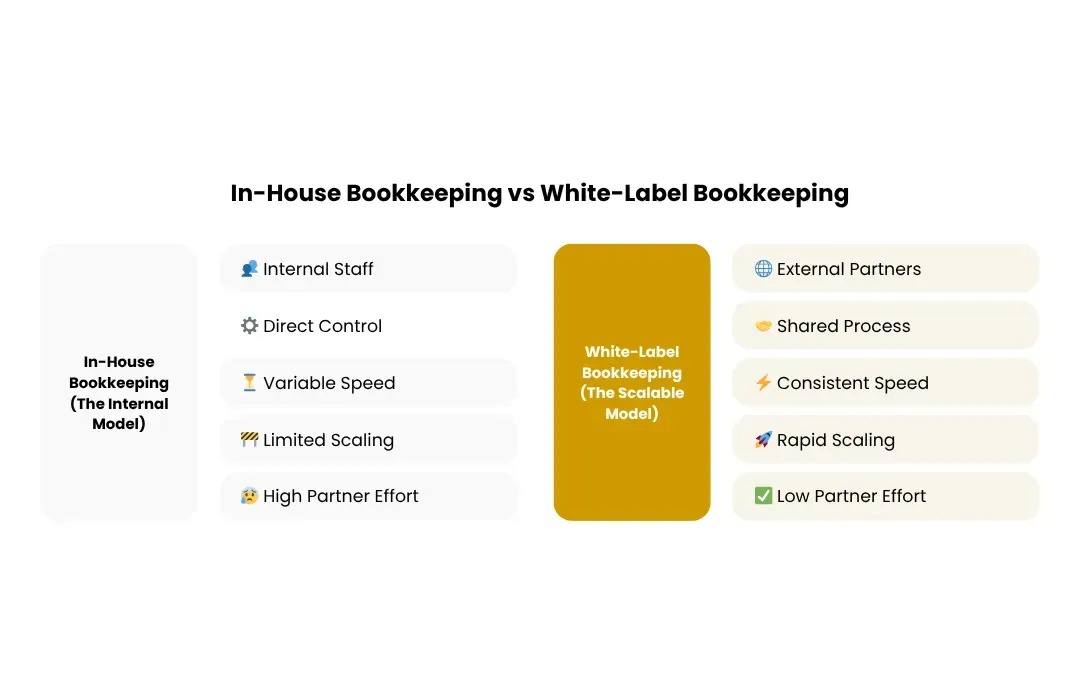
The problem usually looks like this:
- client books arrive late or messy
- year-end files need more cleanup than expected
- staff are pulled into recurring bookkeeping questions
- partners want to grow advisory work but keep getting dragged back into monthly processing
- the firm knows clients need help, but does not want more full-time hiring risk
That tension is real. A firm can either say no to bookkeeping, do it inefficiently, or build a delivery model that does not rely only on internal headcount.
That is where white label bookkeeping for CPA firms fits.
What White-Label Bookkeeping Looks Like in Practice
In practice, white-label bookkeeping means an external team handles the bookkeeping operations behind the scenes while the CPA firm remains the client-facing relationship.
The client still experiences one brand, one advisory relationship, and one trusted accounting partner. The difference is operational: the bookkeeping delivery is powered by a specialist team working in the background.
A strong white-label setup usually includes:
- monthly bookkeeping
- reconciliations
- accounts payable and receivable support
- payroll support, where relevant
- sales tax support
- cleanup and catch-up work
- month-end reporting packages
- collaboration with the CPA firm ahead of tax season or year-end
The goal is not to replace the CPA firm. It is to strengthen it.
For firms focused on tax, assurance, or advisory, this model keeps the recurring bookkeeping workflow moving without requiring partners to become operations managers for a separate bookkeeping department.
How It Benefits Your Clients
Clients usually do not care whether the bookkeeping sits inside your office or behind a white-label partner. They care about the outcome.
They want:
- timely books
- fewer surprises at year-end
- better use of cloud systems
- smoother communication
- cleaner handoff into tax and advisory work
That is why a good white-label model can actually improve the client experience.
Instead of reactive bookkeeping, the client gets a more consistent process. Instead of year-end panic, the firm has cleaner numbers to work with. Instead of fragmented support, the client sees a more seamless service line.
There is also a technology upside. Many bookkeeping partners already work inside modern cloud systems and standardized workflows. That means the CPA firm does not have to reinvent every process internally just to offer a better bookkeeping experience.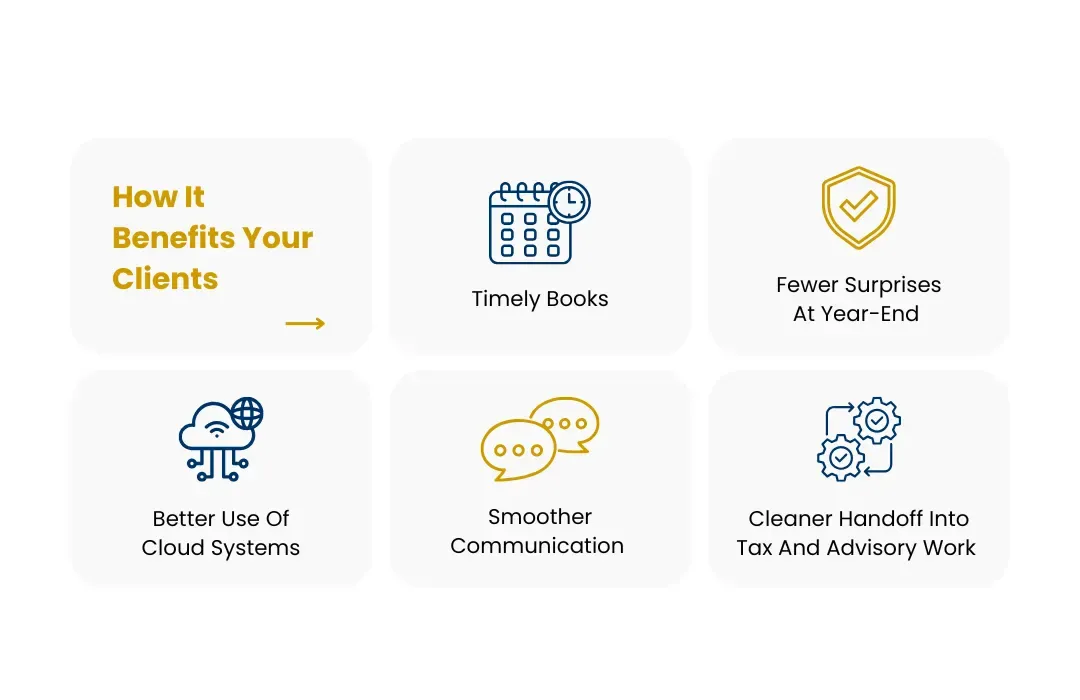
Revenue Model: Markup, Pass-Through, or Referral?
This is one of the first questions firms ask: how does the economics work?
There is no single right answer, but most models fall into three buckets.
1. Markup model
The white-label partner charges the CPA firm a wholesale fee, and the firm sets the final client price.
This works well when the firm wants to own pricing, client communication, and packaging. It also gives the firm room to bundle bookkeeping with tax or advisory support.
2. Pass-through model
The bookkeeping cost is passed through with little or no markup, and the firm treats it as a client-retention or delivery-support tool.
This can make sense when the bookkeeping relationship protects a valuable tax, review, or advisory client.
3. Referral model
The firm introduces the bookkeeping provider directly and earns a referral fee or simply keeps the relationship informal.
This is the lightest model operationally, but it also gives the firm less control over the client experience.
For many CPA firms, the best answer is not purely financial. It is strategic. The real question is: do you want bookkeeping to be a branded part of your service model, or just a solution you point clients toward?
Example: How One CPA Firm Freed Up Advisory Capacity
Consider a firm that mainly focuses on tax and year-end work.
The partners keep seeing the same issue: good clients need bookkeeping help, but the firm does not want to hire, train, and supervise a separate bookkeeping team. So files arrive incomplete, year-end work takes longer, and advisory conversations keep getting delayed because the books are not ready.
The firm brings in a white-label bookkeeping partner.
Now the workflow changes:
- monthly bookkeeping is handled consistently
- client records are cleaner throughout the year
- year-end preparation is less painful
- partners spend less time on cleanup
- the firm has more room to sell planning, CFO, and advisory work
That is the real value. White-label bookkeeping is not just about offloading tasks. It is about protecting partner time and creating more space for higher-value work.
Final Thoughts
White-label bookkeeping works best when a CPA firm already has trust, strong client relationships, and a clear tax or advisory offering, but lacks the internal bandwidth to deliver recurring bookkeeping efficiently.
It is not a shortcut for poor service. It is a scaling model.
Done right, it helps firms:
- expand service lines without immediate hiring
- improve delivery consistency
- reduce internal bottlenecks
- create more advisory capacity
- keep more good clients under one umbrella
FAQs
What is white-label bookkeeping for CPA firms?
It is a model where an external bookkeeping team delivers services behind the scenes while the CPA firm remains the primary client-facing brand and relationship owner.
Is white-label bookkeeping the same as referring bookkeeping out?
Not exactly. A referral sends the client elsewhere. White-label bookkeeping is usually more integrated and designed to feel like part of the CPA firm’s own service delivery.
Does this only work for larger firms?
No. In many cases, smaller and mid-sized firms benefit most because they often feel the staffing squeeze more directly. Qualified staffing remains a leading concern across firm sizes in current practice-management guidance.
Why is this model growing now?
Because firms are trying to solve two issues at once: capacity pressure and demand for broader advisory support. AICPA/CIMA materials describe CAS as one of the fastest-growing areas in public accounting and an area of significant growth in recent years.
Legal Disclaimer
This article is provided by Orbit Accountants for general informational purposes only and does not constitute legal, tax, accounting, or regulatory advice. How a CPA firm structures white-label bookkeeping relationships depends on its service model, client terms, professional responsibilities, and jurisdiction-specific rules. You should review branding, engagement, confidentiality, workflow, and professional compliance issues before entering into any partnership arrangement. For advice specific to your situation, consult a qualified accountant or legal professional or book a free consultation with Orbit Accountants to explore whether a partnership model is the right fit.