

Balance Sheet: Complete Guide
As a business owner, understanding your financial position isn’t optional—it’s essential. One of the most reliable tools for doing that is the balance sheet. At its core, a balance sheet shows what your business owns, what it owes, and what’s left for you as the owner at a specific point in time.
Unlike profit-focused reports, a balance sheet is about stability and strength. It helps lenders assess risk, investors evaluate opportunity, and business owners make informed decisions with confidence. More importantly, it removes guesswork. When you know exactly where your business stands financially, planning becomes far less stressful.
This guide walks you through everything you need to know about balance sheets—what they are, how they work, and how to prepare one properly.
What Is a Balance Sheet?
To understand the role a balance sheet plays in your business, it helps to start with its basic purpose.
A balance sheet is a financial statement that provides a snapshot of your company’s financial position on a specific date. It summarizes three core elements:
- What the business owns
- What the business owes
- The value that belongs to the owners
Because it reflects a single point in time, a balance sheet is often described as a financial “snapshot.” While income statements show performance over a period, the balance sheet shows financial health and resilience.
Balance Sheet Meaning Explained
When people ask, “What is the meaning of a balance sheet?”, the simplest answer is this:
it shows how strong or weak a business is financially at a given moment.
The statement is divided into two sides:
- The asset side, which lists everything the business controls or owns
- The liability and equity side, which shows how those assets are financed
If the balance sheet is prepared correctly, the two sides will always balance. This relationship forms the foundation of accounting and helps ensure financial accuracy.
Components of a Balance Sheet
Each section of the balance sheet plays a distinct role. Together, they tell the full financial story of a business.
Assets and Their Types
Assets represent the resources a business uses to operate and grow. They are generally grouped into two categories:
Current assets
These are assets expected to be used, sold, or converted into cash within one year. Common examples include:
- Cash and bank balances
- Accounts receivable
- Inventory
Non-current assets
These are long-term resources that support the business over several years, such as:
- Property or office space
- Equipment and machinery
- Furniture and technology
Assets reflect not only what a business owns today, but also its ability to operate and expand in the future.
Liabilities and Their Types
Liabilities represent obligations—money the business owes to others.
Short-term (current) liabilities
These are debts due within one year, including:
- Supplier bills
- Payroll obligations
- Short-term loans
Long-term liabilities
These are obligations that extend beyond one year, such as:
- Business loans
- Mortgages
- Long-term financing agreements
Reviewing liabilities helps business owners understand cash pressure and assess whether current resources are sufficient to meet upcoming commitments.
Equity in a Balance Sheet
Equity represents the owner’s stake in the business after all liabilities are deducted from total assets.
The equity section typically includes:
- Owner’s capital or share investments
- Retained earnings (profits reinvested in the business)
- Adjustments from prior periods
As equity grows over time, it signals increasing financial stability. This is often a key indicator for lenders and investors assessing long-term credibility.
Balance Sheet Sample & Examples
Looking at examples helps bring balance sheets to life. Numbers on their own can feel abstract until you see how they work together.
Simple Balance Sheet Example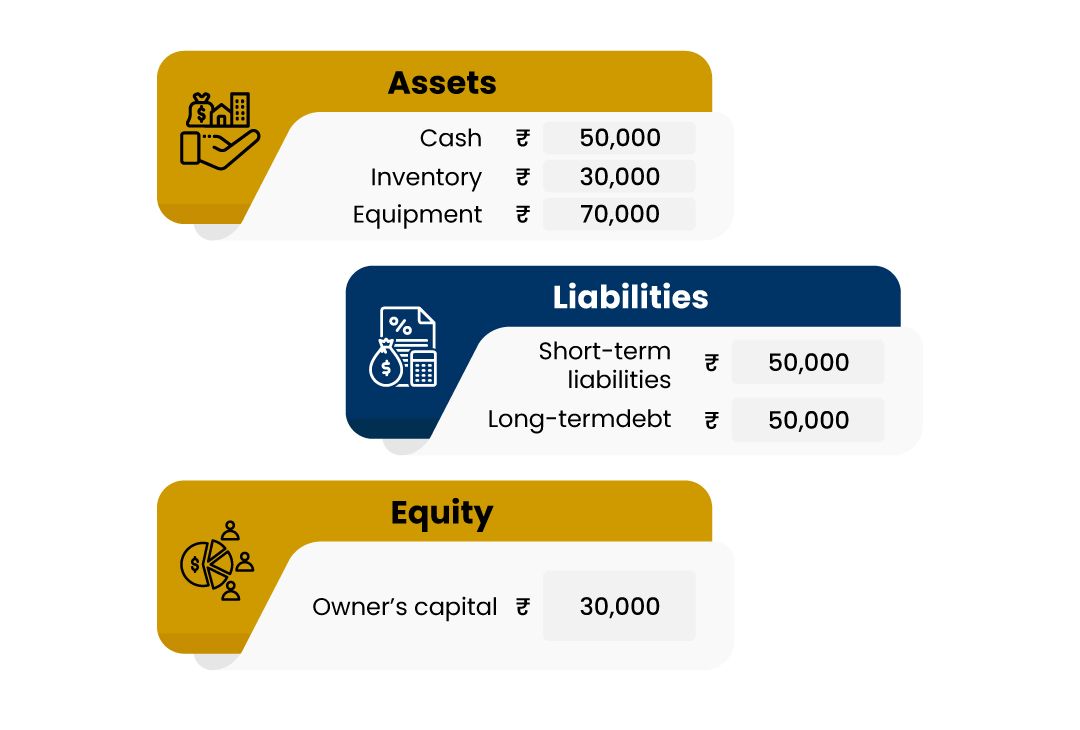
Assets
- Cash: ₹50,000
- Inventory: ₹30,000
- Equipment: ₹70,000
Liabilities
- Short-term liabilities: ₹20,000
- Long-term debt: ₹60,000
Equity
- Owner’s capital: ₹70,000
In this example, total assets equal total liabilities plus equity. That balance confirms the financial position has been recorded correctly.
A statement of financial position like this allows business owners to quickly assess liquidity, debt exposure, and owner value at a specific date.
Why Is a Balance Sheet Important?
A balance sheet is more than an accounting requirement—it’s a decision-making tool.
Banks rely on balance sheets when approving loans. Investors review them before committing capital. Business owners use them to determine whether the company can:
- Pay its bills
- Fund growth
- Handle unexpected downturns
Over time, balance sheets also reveal trends. Improving equity, declining debt, or stronger liquidity can signal healthy progress. Warning signs, on the other hand, become visible early—before they turn into bigger problems.
How to Prepare a Balance Sheet
Preparing a balance sheet doesn’t need to be complicated when broken into clear steps.
- List all assets, including cash, receivables, inventory, and long-term items
- Record all liabilities, separating short-term and long-term obligations
- Calculate equity by subtracting total liabilities from total assets
- Review for accuracy to ensure the two sides balance
Many businesses use a classified balance sheet, which organizes assets and liabilities into clear categories. This format improves readability and makes financial analysis easier for external users.
Accounting software and balance sheet templates can simplify the process, especially when preparing monthly or quarterly statements.
Frequently Asked Questions
What is a classified balance sheet?
A classified balance sheet organizes assets and liabilities into structured categories, such as current and non-current. This makes the statement easier to read and analyze.
Why is the balance sheet important for businesses?
The balance sheet shows financial strength, debt capacity, and owner value. It helps assess risk, stability, and long-term sustainability.
Can I use a balance sheet template?
Yes. Many free and paid templates are available online, especially for small businesses and startups. Most accounting software also generates balance sheets automatically.
How often should a balance sheet be prepared?
Many businesses prepare balance sheets monthly or quarterly to track trends and support planning. Annual balance sheets are typically required for tax and reporting purposes.
What does a balance sheet tell you about a company?
It shows what a company owns, what it owes, and what belongs to the owners—providing a clear picture of overall financial position.